
FintechZoom.io Nasdaq: What Is It, How Does It Work, and Can You Trust It?
Finding reliable stock market information can be difficult, especially when different financial websites display charts, prices, and market predictions. Investors need clear information to understand market movements and make better research decisions. FintechZoom.io Nasdaq is a search term associated with Nasdaq-related financial coverage on FintechZoom.io. Understanding what the website offers, how Nasdaq indexes work, and where to verify financial information can help readers avoid confusion and approach market research with greater confidence.
What Is FintechZoom.io Nasdaq?
FintechZoom.io Nasdaq refers to Nasdaq-related financial information that readers look for on the FintechZoom.io website. The website’s homepage describes its coverage of financial markets, including Nasdaq, Dow Jones, cryptocurrency, and technology-related investments.
Its Nasdaq coverage introduces readers to market movements, technology companies, earnings reports, and financial developments. This information can help beginners understand what happens in the stock market and why investors follow major indexes.
However, it is important to understand the difference between a financial information website and an actual stock exchange. FintechZoom.io is not the Nasdaq Stock Market. Readers should also verify the website’s identity, ownership, and data sources rather than assuming that every website using the FintechZoom name belongs to the same organization.
What Does FintechZoom.io Offer for Nasdaq Research?
The website presents Nasdaq as one of its main financial coverage areas. Its homepage highlights technology companies, earnings reports, market developments, and industry analysis.
Readers researching FintechZoom.io Nasdaq may be interested in several types of financial information:
- Market updates: Information about changes in stock market conditions.
- Technology stock coverage: Developments involving major technology companies.
- Earnings reports: Company financial results and business performance.
- Market analysis: Discussions about factors that influence stock prices.
- Financial education: Explanations of market concepts and investment topics.
- Index research: Information about major market indexes and their movements.
These subjects can help readers develop a better understanding of financial markets. However, the availability of a topic on the homepage does not establish the accuracy, freshness, or source of its underlying data.
Is FintechZoom.io the Same as Nasdaq?
No. These are two different entities with different purposes.
Nasdaq operates a major U.S. stock exchange and provides financial market services, including indexes and market data. FintechZoom.io is a separate website that presents financial information.
The distinction is important because readers should not confuse third-party financial coverage with official exchange information.
There is also a significant domain-related concern. FintechZoom.com identifies itself as the official FintechZoom domain and has published a security warning that specifically lists fintechzoom.io among websites it says are not affiliated with it. This warning comes from FintechZoom.com itself, so readers should consider it a first-party claim rather than an independent security investigation.
Important: Verify the domain before entering personal information, connecting financial accounts, downloading files, or making payments.
What Is the Nasdaq Stock Market?
Nasdaq is one of the world’s major financial market operators. Its stock exchange provides a marketplace where eligible companies can list their shares and investors can trade securities through brokerage firms.
Nasdaq became particularly well known for its technology and innovation-focused companies. However, its listed businesses operate across several industries, including healthcare, consumer services, telecommunications, and financial services.
The Nasdaq Stock Market and Nasdaq indexes are related but different concepts. The exchange provides the marketplace, while indexes measure the performance of selected groups of securities.
Understanding this difference makes it easier to interpret financial information found through FintechZoom.io Nasdaq searches.
Nasdaq Composite vs. Nasdaq-100: What Is the Difference?
Two commonly discussed indexes are the Nasdaq Composite and Nasdaq-100. Although both carry the Nasdaq name, they measure different groups of companies.
Nasdaq Composite Index
The Nasdaq Composite measures eligible domestic and international common-type stocks listed on the Nasdaq Stock Market.
It covers thousands of securities and provides a broad view of companies listed on the exchange. Its market-capitalization weighting means larger companies can have a greater influence on its performance.
Nasdaq-100 Index
The Nasdaq-100 tracks 100 of the largest domestic and international non-financial companies listed on Nasdaq, subject to its index rules.
It is particularly useful for understanding the performance of major large-cap businesses across technology, consumer, healthcare, and other industries.
Nasdaq explains the different construction and eligibility rules for these indexes in its official documentation.
Complete Comparison Table
| Feature | Nasdaq Composite | Nasdaq-100 |
| Main purpose | Broad Nasdaq market measurement | Tracks large non-financial companies |
| Coverage | Thousands of eligible securities | 100 eligible companies |
| Company size | Large, medium, and smaller companies | Among the largest companies |
| Financial companies | Can be included | Excluded |
| Weighting | Market capitalization-based | Modified market capitalization-based |
| Market focus | Broad exchange performance | Large-company performance |
| Technology exposure | Significant | Significant |
| Smaller companies | Included when eligible | Generally not included |
| Main use | Understanding wider Nasdaq performance | Following major Nasdaq-listed businesses |
| Official ticker | COMP | NDX |
The two indexes provide different perspectives. The Composite offers broader exchange coverage, while the Nasdaq-100 focuses on a selected group of large non-financial companies.
How Does FintechZoom.io Nasdaq Market Information Help Beginners?
New investors often struggle to understand why stock prices change. Financial news, company announcements, interest rates, and economic developments can all influence market activity.
Reading financial coverage can help beginners connect these events with market movements.
For example, consider a situation where a major technology company reports stronger-than-expected earnings. Investors may respond positively if the results suggest improving business performance.
Similarly, disappointing earnings or weaker financial guidance may create selling pressure.
When researching FintechZoom.io Nasdaq, readers should use financial articles as starting points rather than complete investment recommendations.
A useful research routine includes:
- Identify the company or index being discussed.
- Check the date and publication time.
- Read the original company announcement.
- Compare the reported market movement with official data.
- Consider the wider economic environment.
- Avoid making decisions based on a single prediction.
How to Read Nasdaq Stock Charts and Market Data
Stock charts help investors understand how a security has performed over a particular period. They display price movements and can reveal patterns that deserve further research.
Before interpreting a chart through FintechZoom.io Nasdaq, understand these important terms.
| Chart Element | Meaning | Why It Matters |
| Opening price | Price at the beginning of a trading session | Shows the starting market level |
| Closing price | Final official session price | Helps compare daily performance |
| Day high | Highest recorded price during a session | Shows the upper trading range |
| Day low | Lowest recorded price during a session | Shows the lower trading range |
| Trading volume | Number of shares traded | Helps measure market participation |
| Moving average | Average price over a selected period | Helps identify broader trends |
| Market capitalization | Total market value of a company’s outstanding shares | Indicates company size |
| Percentage change | Relative price movement | Makes comparisons easier |
| Previous close | Closing price from the previous session | Provides a comparison point |
| Volatility | Degree of price fluctuation | Helps assess market uncertainty |
Understanding Green and Red Price Movements
Many financial platforms use colors to make charts easier to understand.
- Green often represents a positive price movement.
- Red often represents a negative price movement.
- A flat or neutral indicator may represent little change.
Color conventions can differ between platforms, so always check the chart legend.
Why Trading Volume Matters
Price movements alone do not explain the entire market situation. Trading volume provides additional information about how actively investors are buying and selling a security.
For example, a price increase accompanied by higher trading volume may indicate stronger participation. However, volume cannot guarantee that a trend will continue.
Which Companies Influence Nasdaq Market Performance?
Large companies can have a meaningful effect on major stock market indexes because of their market capitalization and index weighting.
Some well-known Nasdaq-listed businesses include:
| Company | Stock Symbol | Main Industry | Business Focus |
| Apple | AAPL | Technology | Consumer electronics and software |
| Microsoft | MSFT | Technology | Software and cloud computing |
| NVIDIA | NVDA | Semiconductors | Graphics processors and AI computing |
| Amazon | AMZN | Consumer and technology | E-commerce and cloud services |
| Alphabet | GOOGL | Communication services | Search, advertising, and technology |
| Meta Platforms | META | Communication services | Social media and digital advertising |
| Tesla | TSLA | Automotive | Electric vehicles and energy |
| Broadcom | AVGO | Semiconductors | Semiconductor and infrastructure software |
These companies operate in different areas of the economy. Their financial results, business strategies, and market valuations can influence investor sentiment.
Readers following FintechZoom.io Nasdaq should remember that a company’s inclusion in Nasdaq-listed stocks does not automatically mean it belongs to every Nasdaq index.
What Factors Affect Nasdaq Market Movements?
Nasdaq prices can change because of several financial and economic factors. Understanding these influences helps investors interpret market news more carefully.
1. Interest Rates
Interest rates influence borrowing costs, business investment, and the value investors place on future earnings.
When interest rates rise, some growth stocks may face additional valuation pressure. Lower rates can support certain growth-oriented investments, although market reactions depend on economic conditions.
2. Company Earnings
Quarterly earnings reports reveal how businesses perform financially.
Investors commonly examine:
- Revenue growth
- Net income
- Earnings per share (EPS)
- Operating expenses
- Future business guidance
- Cash flow
Strong results can improve investor confidence, while disappointing results can create uncertainty.
3. Inflation
Inflation affects consumer purchasing power, company expenses, and monetary policy.
Higher inflation may increase production costs and influence central bank decisions. These developments can affect stock valuations.
4. Artificial Intelligence and Technology
Artificial intelligence, cloud computing, semiconductor development, and cybersecurity are important areas of technological investment.
Companies working in these industries may attract investor attention because of their potential growth opportunities. However, expectations about future growth can also create high valuations and additional volatility.
5. Global Economic Conditions
International trade, geopolitical developments, currency movements, and economic growth can influence financial markets.
Investors should consider these factors alongside company-specific developments when studying Nasdaq performance.
How to Verify Financial Information Before Investing
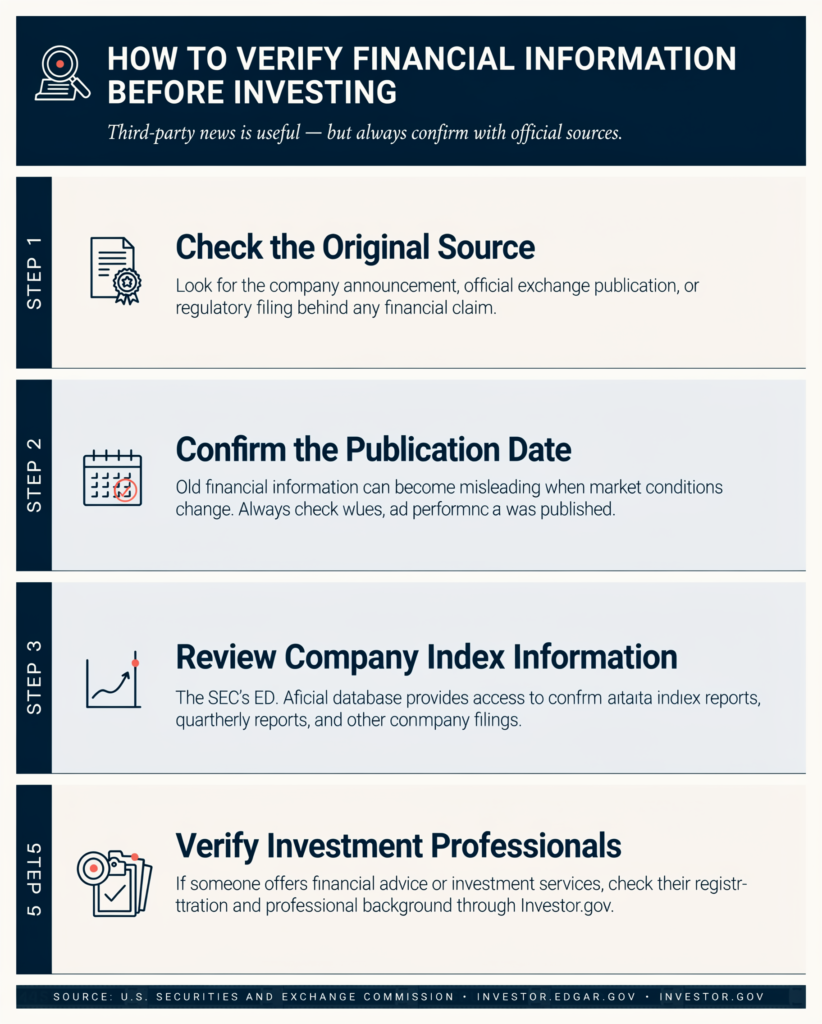
Financial information deserves careful checking, especially when it comes from third-party websites.
A chart or financial article may provide useful context, but readers should confirm important information through official sources.
When using FintechZoom.io Nasdaq coverage, follow these verification steps:
Step 1: Check the original source
Look for the company announcement, official exchange publication, or regulatory filing behind a financial claim.
Step 2: Confirm the publication date
Old financial information can become misleading when market conditions change.
Step 3: Compare index information
Use Nasdaq’s official index pages to confirm index definitions, values, and performance information.
Step 4: Review company filings
The SEC’s EDGAR database provides access to company filings, including annual reports and quarterly reports.
Step 5: Verify investment professionals
If someone offers financial advice or investment services, check their registration and professional background through Investor.gov.
The U.S. Securities and Exchange Commission provides investor research resources and guidance for checking financial professionals.
Is FintechZoom.io Nasdaq Safe and Reliable?
This question requires special attention because financial websites can display information without being official market-data providers.
The first step is to distinguish the website’s financial content from its domain identity.
FintechZoom.io describes itself as a financial information platform. However, FintechZoom.com has publicly warned that fintechzoom.io is not affiliated with its official website.
This creates a meaningful identity concern. Readers should not automatically assume that the .io domain is an authorized extension of FintechZoom.com.
Consider these precautions:
- Verify the exact website address.
- Do not share brokerage passwords.
- Never disclose cryptocurrency wallet recovery phrases.
- Avoid downloading unknown financial applications.
- Do not send money based on website advertisements.
- Check whether market information identifies its original data provider.
- Verify investment claims through official sources.
- Be cautious of guaranteed-return promises.
My assessment: The available evidence does not establish fintechzoom.io as an official Nasdaq service or an affiliated FintechZoom.com website. Its financial content should not be treated as independently verified investment information. The domain warning also makes it important to exercise additional caution before interacting with the site.
Can You Buy Nasdaq Stocks Through FintechZoom.io?
Readers should understand that researching stocks and purchasing securities are two different activities.
A financial information website may discuss companies, display market information, or explain investment concepts. That does not mean it provides brokerage services.
To purchase Nasdaq-listed shares, investors generally need an eligible brokerage account.
The usual process involves:
- Choosing a regulated brokerage service.
- Completing its identity verification requirements.
- Funding the account through an accepted payment method.
- Searching for the correct company ticker.
- Reviewing the security and associated risks.
- Placing an order according to the broker’s available options.
For readers researching FintechZoom.io Nasdaq, the key point is that the website’s market coverage should not be confused with an ability to execute trades.
What Are the Advantages and Limitations of Nasdaq Research Websites?
Financial research websites can make market information easier to understand. However, they also have limitations that readers should consider.
| Area | Potential Advantage | Important Limitation |
| Market news | Helps readers follow financial developments | News may not always be updated immediately |
| Stock charts | Makes price movements easier to understand | Charts may use delayed data |
| Company analysis | Introduces business performance | Analysis may not include every important detail |
| Financial education | Helps beginners learn terminology | Educational content is not personalized advice |
| Market trends | Provides broader market context | Past performance does not predict future results |
| Index coverage | Helps compare market movements | Different indexes measure different securities |
| Investment research | Offers ideas for further investigation | Readers must independently verify important claims |
| Technology coverage | Highlights developing industries | Growth expectations can be uncertain |
The best approach is to combine educational material with official market information and company disclosures.
How Should Beginners Use FintechZoom.io Nasdaq Information?
Beginners should focus on understanding the market before making investment decisions.
A structured approach can reduce confusion and help build better financial knowledge.
Here is a practical research routine:
Daily research
- Review major financial headlines.
- Check the direction of the Nasdaq Composite.
- Follow important company announcements.
- Observe changes in trading volume.
Weekly research
- Compare index performance.
- Review earnings announcements.
- Study major economic developments.
- Identify important industry trends.
Monthly research
- Evaluate broader market performance.
- Review company financial statements.
- Compare business growth and valuation.
- Reassess investment risks and financial goals.
This approach can make FintechZoom.io Nasdaq research more useful when combined with independent verification.
What Is the Future of Nasdaq and Financial Technology?
Financial technology continues to change how people access and understand market information.
Artificial intelligence, automated data processing, cloud computing, and advanced analytical tools are becoming increasingly important in financial services.
These developments may improve how investors research companies and interpret market information.
Several areas deserve attention:
- Artificial intelligence: AI can help process financial information and identify patterns.
- Cloud computing: Businesses increasingly depend on cloud infrastructure.
- Semiconductors: Advanced chips support computing, automation, and AI applications.
- Cybersecurity: Financial institutions require stronger systems to protect sensitive information.
- Financial automation: Digital platforms can simplify certain research and reporting processes.
However, technological progress does not remove investment risk. Market valuations, competition, regulation, and economic conditions will continue to influence company performance.
For readers exploring FintechZoom.io Nasdaq, understanding these developments provides useful background for studying the financial technology sector.
Best Official Sources for Nasdaq and Financial Research
Readers should prioritize original sources whenever they need accurate financial information.
The following resources provide useful starting points:
| Official Source | Information Available | Best Use |
| Nasdaq Composite | Index description and methodology | Understanding broad Nasdaq performance |
| Nasdaq-100 Index | Index information and constituent details | Researching major non-financial companies |
| SEC Investor.gov | Investment research and investor education | Learning how to evaluate investments |
| Investor.gov Ask and Check | Professional registration and verification | Checking investment professionals |
| FintechZoom.com Security Notice | Official-domain and impersonation warning | Understanding the domain-related concern |
These sources provide a stronger foundation for financial research than relying on an individual article or market prediction.
Frequently Asked Questions
1. What is FintechZoom.io Nasdaq?
FintechZoom.io Nasdaq is a search phrase associated with Nasdaq-related financial coverage on FintechZoom.io. It refers to financial information and market topics, not a separate stock, exchange, or investment product.
2. Is FintechZoom.io an official Nasdaq website?
No. Nasdaq operates its own official website and financial market services. FintechZoom.io is a separate domain and should not be presented as an official Nasdaq platform.
3. Is FintechZoom.io the same as FintechZoom.com?
No affiliation has been established between the two domains. FintechZoom.com identifies itself as the official domain and specifically lists fintechzoom.io in its warning about unaffiliated websites. Readers should verify the website before sharing personal or financial information.
4. What is the difference between Nasdaq Composite and Nasdaq-100?
The Nasdaq Composite covers thousands of eligible Nasdaq-listed securities. The Nasdaq-100 tracks 100 of the largest eligible non-financial companies listed on Nasdaq.
5. Can beginners use FintechZoom.io for stock market research?
Beginners should first verify the website’s identity and the reliability of its information. Official Nasdaq resources, company financial reports, and SEC investor education materials provide useful sources for independent research.
6. Can FintechZoom.io predict Nasdaq stock prices?
No website can guarantee future stock prices. Financial analysis may discuss possible market movements, but actual prices depend on earnings, economic conditions, investor sentiment, and unexpected events.
Conclusion
Understanding FintechZoom.io Nasdaq requires more than looking at stock charts or reading market headlines. Readers should know the difference between a financial information website, an official stock exchange, and the indexes used to measure market performance.
The Nasdaq Composite and Nasdaq-100 offer different perspectives on the market, while company earnings, economic developments, and technological changes help explain price movements.
One particularly important consideration is the domain warning published by FintechZoom.com. Readers should verify the identity of fintechzoom.io rather than assume it is affiliated with the official FintechZoom website.
For better financial research, prioritize official Nasdaq information, SEC resources, and original company announcements. Understanding your sources is an essential step toward making informed financial decisions.
Have you used FintechZoom.io for Nasdaq research? Share your experience and thoughts in the comments to help other readers understand the platform.