

5StarsStocks.com Healthcare: What Should Investors Know?
Healthcare is one of the most important industries in the global economy, but choosing the right stocks can be difficult. Pharmaceutical companies, biotechnology developers, hospitals, and medical technology businesses all operate under different market conditions. 5starsstocks.com healthcare provides a starting point for exploring this investment category, but investors need more than a company name or stock rating to make informed decisions. Understanding business performance, medical innovation, regulatory requirements, and financial risks can help investors evaluate opportunities with greater confidence.
What Is 5StarsStocks.com Healthcare?
5StarsStocks.com is an investment information website that organizes stock market content by industry, investment style, and company category. Its healthcare section focuses on the healthcare industry, giving readers a starting point for learning about companies connected to medicine, pharmaceutical products, biotechnology, and healthcare services.
The website’s healthcare category is relevant to investors who want to explore companies operating in different parts of the medical industry. However, readers should distinguish between educational investment content and independently verified financial research.
When exploring 5starsstocks.com healthcare, investors should consider three important questions:
- What types of healthcare businesses does the website discuss?
- Which financial and industry indicators should investors examine?
- How can readers verify company information before investing?
These questions help turn general stock market information into a practical research process.
Why Is the Healthcare Sector Important for Investors?
Healthcare plays an essential role in everyday life. People need medicines, medical equipment, diagnostic services, hospitals, insurance coverage, and long-term treatment regardless of short-term economic conditions.
This creates demand across several parts of the industry. However, consistent demand does not mean every healthcare company will generate profits or deliver positive stock returns.
According to the Centers for Medicare & Medicaid Services (CMS), US national healthcare expenditure reached approximately $5.3 trillion in 2024, representing 18% of the country’s gross domestic product.
This figure demonstrates the economic importance of healthcare and the scale of the market in which these companies operate.
Investors may examine this sector for several reasons:
- Long-term demand: Medical services remain important across different economic conditions.
- Medical innovation: New treatments and technologies can create business opportunities.
- Population changes: Aging populations can increase demand for certain medical services.
- Different business models: Investors can research pharmaceutical manufacturers, hospitals, equipment makers, and other companies.
- Potential portfolio diversification: Healthcare businesses may respond to different economic factors than companies in other industries.
However, investors must evaluate each company individually rather than assuming the entire sector will perform equally well.
What Types of Healthcare Stocks Can Investors Explore?
Healthcare is a broad investment category. Understanding its main subsectors helps investors identify businesses that match their research interests and financial objectives.
Pharmaceutical Stocks
Pharmaceutical companies discover, develop, manufacture, and sell prescription medicines and other healthcare products.
Their financial performance may depend on successful drug development, patent protection, product demand, manufacturing capacity, and regulatory approval.
Examples include:
- Pfizer (PFE)
- Merck & Co. (MRK)
- AbbVie (ABBV)
- Bristol Myers Squibb (BMY)
- Eli Lilly (LLY)
Investors should examine product revenue, research and development spending, patent expiration dates, and the company’s future drug pipeline.
Biotechnology Stocks
Biotechnology companies use biological research and advanced technologies to develop treatments, vaccines, and diagnostic solutions.
Some businesses focus on established products, while others depend heavily on experimental treatments.
This difference makes financial analysis particularly important. A company with limited revenue and an experimental treatment pipeline may face greater uncertainty than an established pharmaceutical manufacturer.
Medical Device Stocks
Medical device businesses produce equipment used to diagnose, monitor, and treat medical conditions.
Their products include surgical instruments, imaging equipment, implants, monitoring systems, and robotic surgery technologies.
Examples include:
- Medtronic (MDT)
- Abbott Laboratories (ABT)
- Boston Scientific (BSX)
- Intuitive Surgical (ISRG)
Investors should examine product demand, innovation, hospital purchasing activity, regulatory requirements, and competition.
Healthcare Services Stocks
Healthcare service providers deliver medical care, insurance-related services, laboratory testing, and other patient support.
Examples include:
- HCA Healthcare (HCA)
- CVS Health (CVS)
- UnitedHealth Group (UNH)
- Humana (HUM)
Their performance can depend on patient volume, insurance reimbursement, operating costs, government policies, and medical service demand.
Healthcare Real Estate Investment Trusts
Healthcare REITs own or finance properties used for medical and healthcare activities.
These properties may include hospitals, senior housing facilities, rehabilitation centers, and medical office buildings.
Examples include Welltower (WELL) and Ventas (VTR).
Investors should study rental income, occupancy levels, debt obligations, tenant quality, and interest rate changes before considering these businesses.
Which Healthcare Companies Should Investors Compare?
Investors researching 5starsstocks.com healthcare should compare companies based on their business models rather than relying on brand recognition.
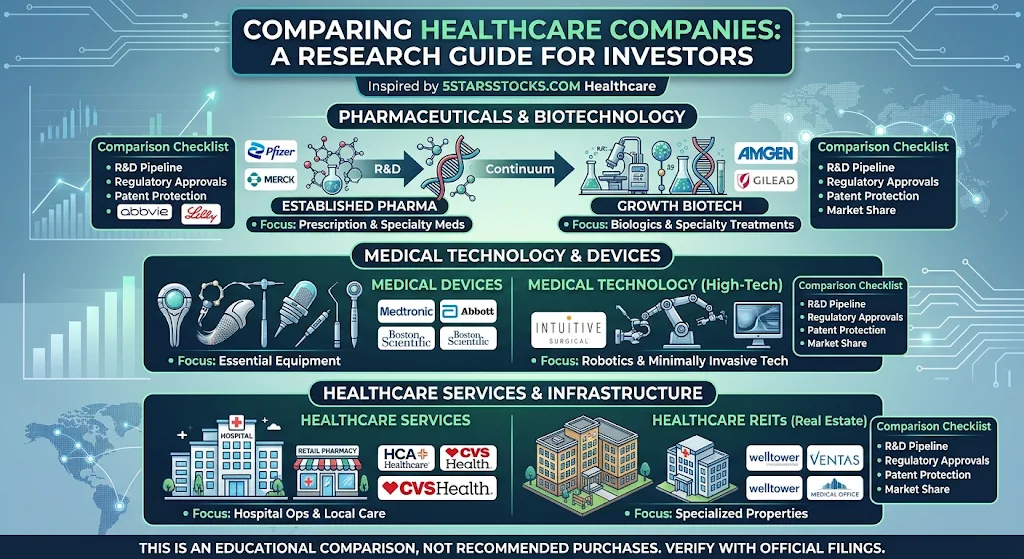
The following table provides examples of established publicly traded companies across different healthcare categories.
| Company | Stock Symbol | Healthcare Category | Main Business Area |
| Pfizer | PFE | Pharmaceuticals | Prescription medicines and vaccines |
| Merck & Co. | MRK | Pharmaceuticals | Medicines and vaccines |
| AbbVie | ABBV | Pharmaceuticals | Immunology and specialty medicines |
| Eli Lilly | LLY | Pharmaceuticals | Diabetes, obesity, and other treatments |
| Amgen | AMGN | Biotechnology | Biologic medicines |
| Gilead Sciences | GILD | Biotechnology | Antiviral and specialty medicines |
| Medtronic | MDT | Medical Devices | Medical equipment and treatment technology |
| Abbott Laboratories | ABT | Medical Devices | Diagnostics and medical products |
| Boston Scientific | BSX | Medical Devices | Minimally invasive medical technology |
| Intuitive Surgical | ISRG | Medical Technology | Robotic-assisted surgical systems |
| HCA Healthcare | HCA | Healthcare Services | Hospital operations |
| CVS Health | CVS | Healthcare Services | Pharmacy and healthcare services |
| Welltower | WELL | Healthcare REIT | Healthcare and senior housing properties |
| Ventas | VTR | Healthcare REIT | Healthcare-related real estate |
Important: This table is an educational comparison, not a list of recommended purchases or a verified ranking from 5StarsStocks.com. Company descriptions are broad business summaries. Investors should confirm current financial information through official company filings.
How Does Healthcare Stock Analysis Work?
Healthcare stock analysis requires more than checking a share price or reading a positive market prediction.
Investors should examine the company’s financial position, business model, competitive environment, and future opportunities.
Here are the most useful areas to investigate.
Revenue Growth
Revenue shows how much money a company generates from selling products or providing services.
Compare revenue across several reporting periods to identify whether the business is growing, remaining stable, or experiencing declining demand.
Also examine where the revenue comes from. A pharmaceutical company that depends heavily on one medicine may face different risks from a business with several successful products.
Earnings and Profit Margins
Revenue growth does not automatically mean profitability.
Review net income, operating income, gross margin, and earnings per share (EPS). These figures help investors understand how efficiently a company converts sales into profits.
A business may report strong sales while facing rising manufacturing, research, staffing, or distribution costs.
Research and Development Spending
Research and development (R&D) plays a major role in pharmaceutical and biotechnology businesses.
Companies invest in discovering new medicines, improving existing treatments, and developing medical technologies.
However, higher R&D spending does not guarantee successful products. Investors should assess whether research spending produces meaningful progress and commercially viable results.
Debt and Cash Flow
Debt can become a problem when companies struggle to generate enough cash to meet their obligations.
Examine:
- Total debt.
- Cash and cash equivalents.
- Operating cash flow.
- Interest expenses.
- Debt maturity schedules.
- Free cash flow.
A healthy financial position can help a company fund operations, research, acquisitions, and future development.
Valuation
Even a successful healthcare company can become an expensive investment when its share price rises faster than its financial performance.
Common valuation measures include:
- Price-to-earnings (P/E) ratio.
- Forward P/E ratio.
- Price-to-sales (P/S) ratio.
- Enterprise value to EBITDA (EV/EBITDA).
- Free cash flow yield.
Compare these figures with relevant competitors and the company’s historical performance. Different healthcare subsectors require different valuation methods.
How Do FDA Approvals Affect Healthcare Stocks?
Regulatory approval is an important factor for pharmaceutical, biotechnology, and medical device businesses.
In the United States, the Food and Drug Administration (FDA) evaluates medicines and medical products before approving them for their intended uses.
The drug development process includes several stages:
- Discovery and development: Researchers identify potential treatments.
- Preclinical research: Scientists conduct laboratory and other early safety studies.
- Clinical research: Researchers test treatments in human participants.
- FDA review: The agency examines submitted evidence and evaluates the product.
- Post-market monitoring: The FDA continues monitoring product safety after approval.
Each stage involves uncertainty, cost, and time.
A promising early-stage medicine may never reach the market. Clinical trial results, unexpected safety concerns, manufacturing issues, or regulatory decisions can change a company’s financial outlook.
Investors should therefore verify approval announcements through official FDA records rather than relying only on promotional headlines.
What Healthcare Industry Trends Should Investors Watch?
Several developments can influence healthcare businesses over the coming years.
Artificial Intelligence in Healthcare
Artificial intelligence is changing how healthcare companies approach medical imaging, administrative work, research, and clinical data analysis.
Companies developing diagnostic software and medical technologies may benefit from wider adoption. However, investors should examine actual commercial results rather than treating AI announcements as proof of future profitability.
Biotechnology Innovation
Advances in biotechnology may create new treatments for complex diseases.
Research involving genetic medicine, immunotherapy, and targeted treatments continues to influence the industry.
Investors should evaluate clinical evidence, development costs, regulatory milestones, and commercial potential.
Aging Population
Older populations often require more medical services, prescription medicines, diagnostic testing, and long-term care.
This demographic trend may support demand for selected healthcare businesses, although competition, affordability, and government policies can affect profitability.
Medical Technology
Robotic surgery, advanced imaging, remote patient monitoring, and improved diagnostic equipment are important areas of development.
Companies that successfully introduce useful products may gain new customers and expand their market presence.
Rising Healthcare Expenditure
Healthcare spending influences hospitals, insurers, pharmaceutical manufacturers, and medical suppliers.
CMS data can help investors understand broader expenditure patterns, but higher industry spending does not guarantee higher profits for every company.
What Are the Biggest Risks of Healthcare Stock Investing?
Healthcare businesses can offer different investment opportunities, but they also face industry-specific challenges.
Investors researching 5starsstocks.com healthcare should understand these risks before making financial decisions.
| Risk Factor | What It Means | Possible Business Impact | What Investors Should Check |
| Regulatory changes | New government rules or approval requirements | Higher costs or delayed products | Regulatory announcements |
| Clinical trial failure | A treatment does not meet study objectives | Lost research investment | Trial results and development stages |
| Patent expiration | Competitors may introduce similar products | Lower revenue and pricing pressure | Patent schedules |
| Product recalls | A product may have safety or quality problems | Legal costs and reputational damage | FDA safety notices |
| Pricing pressure | Medicines or services face lower prices | Reduced profit margins | Pricing policies and margins |
| Competition | Rival companies introduce better or cheaper products | Market share declines | Competitor performance |
| High debt | Financial obligations exceed comfortable levels | Reduced financial flexibility | Debt and cash flow |
| Market volatility | Share prices move sharply | Investment losses | Valuation and market conditions |
Understanding these risks helps investors avoid decisions based only on attractive growth forecasts.
How Can Beginners Research Healthcare Stocks?
Beginners can follow a simple research process before considering any healthcare investment.
Step 1: Understand the business
Identify whether the company develops medicines, manufactures medical equipment, operates hospitals, or provides another healthcare service.
Step 2: Read financial reports
Review annual reports, quarterly earnings, balance sheets, and cash flow statements.
Step 3: Examine industry competition
Compare the company with other businesses offering similar products or services.
Step 4: Check regulatory developments
For pharmaceutical and biotechnology businesses, examine clinical trial updates and regulatory decisions.
Step 5: Review company valuation
Compare share prices with earnings, revenue, cash flow, and relevant industry peers.
Step 6: Understand the risks
Consider debt, product dependence, competition, regulatory exposure, and possible market declines.
Step 7: Create a research-based investment decision
Set clear financial objectives and consider whether the company fits your risk tolerance and investment timeframe.
This process makes healthcare research more structured and reduces dependence on unverified stock tips.
How Can 5StarsStocks.com Healthcare Help With Stock Research?
5StarsStocks.com can serve as an initial information source for readers exploring the healthcare sector.
Its industry-based structure helps visitors discover investment topics and understand the different types of businesses available in the stock market.
However, investors should use the platform as one part of a wider research process.
A practical approach includes:
- Explore the healthcare industry category.
- Identify companies that match your investment interests.
- Research their products and services.
- Compare financial performance.
- Verify important announcements through official sources.
- Examine regulatory developments.
- Review valuation and investment risks.
The key is to use online investment content to identify research questions, then confirm the answers through reliable financial and regulatory records.
What Are the Best Sources for Verifying Healthcare Stock Information?
Reliable research depends on the quality of the information behind an investment decision.
Investors should prioritize original company reports and official government records over anonymous recommendations or unsupported predictions.
| Research Source | Information Available | Why It Matters |
| U.S. Securities and Exchange Commission (SEC) | Annual reports, quarterly reports, financial disclosures | Helps verify company performance and risks |
| Food and Drug Administration (FDA) | Drug approvals, clinical research information, safety updates | Helps verify medical and regulatory developments |
| Centers for Medicare & Medicaid Services (CMS) | Healthcare expenditure and industry statistics | Provides information about healthcare spending |
| Company investor relations pages | Earnings reports, presentations, business updates | Provides company-released financial information |
| ClinicalTrials.gov | Registered clinical studies and trial updates | Helps investigate medical research progress |
For publicly traded US companies, the SEC’s EDGAR database is particularly useful because it provides access to official corporate filings.
Investors can use these records to verify reported revenue, debt, operating results, business risks, and management disclosures.
Is 5StarsStocks.com Healthcare Suitable for Long-Term Investors?
Long-term investors may find healthcare companies interesting because the industry serves important and continuing medical needs.
However, each subsector has a different financial structure and risk profile.
Established pharmaceutical manufacturers may generate revenue from existing medicines, while early-stage biotechnology companies may depend on future research results.
Medical device manufacturers may benefit from product innovation, whereas healthcare REITs depend on property income and financing conditions.
When reviewing 5starsstocks.com healthcare, long-term investors should consider:
- Business quality and competitive advantages.
- Consistent revenue and earnings performance.
- Financial stability and debt levels.
- Product development and innovation.
- Regulatory exposure.
- Management decisions.
- Valuation compared with future business prospects.
A long investment timeframe does not remove the risk of permanent capital loss. Investors still need to review their holdings and update their research when business conditions change.
Healthcare Stocks vs. Healthcare ETFs: Which Option Is Better?
Investors can access the healthcare industry through individual company shares or exchange-traded funds (ETFs).
Individual stocks provide exposure to a specific business, while healthcare ETFs generally hold multiple companies within one investment product.
The right choice depends on an investor’s research skills, financial objectives, and willingness to accept company-specific risk.
| Comparison | Individual Healthcare Stocks | Healthcare ETFs |
| Investment structure | Shares of one company | Basket of multiple investments |
| Diversification | Depends on the selected company | Usually spreads exposure across holdings |
| Research requirements | Detailed company research | Fund and underlying holdings research |
| Company-specific risk | Higher concentration | Generally reduced through multiple holdings |
| Potential returns | Depend on individual company performance | Depend on the overall fund portfolio |
| Management | Investor selects each company | Fund follows its stated investment strategy |
| Costs | Trading fees may apply | Expense ratio and trading costs may apply |
| Best suited for | Investors comfortable researching businesses | Investors seeking broader sector exposure |
Healthcare ETFs can simplify sector exposure, but they do not eliminate market risk. Investors should check fund holdings, expense ratios, concentration, and investment objectives before purchasing.
How Should Investors Build a Balanced Healthcare Investment Strategy?
A balanced approach starts with understanding how much risk an investor can accept.
Instead of choosing companies based on popularity, investors can research different healthcare subsectors and assess their individual business characteristics.
Consider these practical guidelines:
- Avoid depending entirely on one biotechnology company or experimental treatment.
- Compare established businesses with smaller growth companies.
- Review financial statements before purchasing shares.
- Understand the difference between revenue growth and sustainable profitability.
- Consider healthcare ETFs if broader exposure matches your goals.
- Avoid investing money needed for immediate expenses.
- Review your portfolio periodically.
- Consult a qualified financial adviser when you need personalized investment guidance.
Diversification can help manage concentration risk, although it cannot prevent losses when markets decline.
What Should Investors Check Before Trusting a Healthcare Stock Rating?
A five-star rating may look attractive, but a rating alone cannot establish whether an investment is suitable.
Investors should understand how the rating was calculated, which information it uses, and when the underlying research was updated.
Before relying on a stock rating, check:
- Rating methodology: Does the publisher explain how it evaluates companies?
- Financial evidence: Does the analysis include revenue, earnings, debt, and cash flow?
- Research date: Is the information current?
- Risk disclosure: Does the analysis explain possible losses?
- Source quality: Can readers verify the claims through official records?
- Conflicts of interest: Does the publisher disclose sponsorships or financial relationships?
- Performance claims: Are historical results documented and presented fairly?
These checks are particularly important when reviewing online investment platforms, including 5starsstocks.com healthcare.
A rating should support further research, not replace it.
Frequently Asked Questions
1. What is 5StarsStocks.com healthcare?
Short answer: It refers to the healthcare investment category on 5StarsStocks.com. The category helps readers explore healthcare-related companies and investment topics. It can serve as an introductory research resource, but investors should verify company information independently.
2. Does 5StarsStocks.com provide healthcare stock recommendations?
Short answer: The website publishes stock market research and investment-related content, but its recommendations should not be treated as personalized financial advice. Readers should examine the available research, check its methodology, and confirm financial information through official company disclosures before making investment decisions.
3. Which healthcare stocks should beginners research?
Short answer: Beginners can start by researching established pharmaceutical, biotechnology, medical device, and healthcare service companies. Examples include Pfizer, Merck, Abbott Laboratories, Medtronic, and HCA Healthcare. These companies operate in different areas, so investors should compare their financial performance, business models, and risks.
4. Are healthcare stocks safe investments?
Short answer: No healthcare stock is completely risk-free.Companies can experience clinical trial failures, regulatory setbacks, product recalls, competition, pricing pressure, and financial difficulties. Investors should research these risks before purchasing shares.
5. How can investors identify promising healthcare companies?
Short answer: Review financial strength, product demand, innovation, competitive position, valuation, and regulatory developments. Investors should also examine annual reports, quarterly results, clinical trial records, and official company announcements. A strong business should have evidence to support its future growth prospects.
6. Is 5StarsStocks.com healthcare suitable for long-term investment research?
Short answer: It can be an introductory resource, but long-term investment decisions require independent research. Investors should combine industry information with company financial statements, regulatory records, valuation analysis, and risk management. A single website or stock rating should never determine an entire investment strategy.
Conclusion
Healthcare offers investors access to a wide range of businesses, from pharmaceutical manufacturers and biotechnology developers to medical device companies and healthcare service providers. Each category has different growth opportunities, financial requirements, and risks.
5starsstocks.com healthcare can provide a starting point for discovering healthcare investment topics, but successful research requires independent verification. Compare company financial statements, investigate regulatory developments, understand product pipelines, and assess valuations before making decisions.
The most valuable investment approach is not simply finding a popular healthcare stock. It is understanding the business, identifying the risks, and making decisions based on reliable evidence. Take time to research each opportunity and build an investment strategy that matches your financial goals.