How Does Tomoson Work? A Complete Guide for 2026
People often discover Tomoson while searching for ways to connect with brands, promote products, or earn opportunities through online reviews. However, understanding the platform’s actual process, costs, and requirements can be confusing. If you are researching how does tomoson work, this guide explains its published influencer-marketing model, the responsibilities of brands and creators, and what you should check before signing up.
What Is Tomoson?
Tomoson is a website historically associated with influencer marketing and product-review campaigns. Its marketplace model connects businesses with bloggers, social media creators, and micro-influencers who want to collaborate with brands.
The platform’s published documentation describes a system where companies promote products through creator partnerships. Instead of contacting hundreds of bloggers individually, businesses can publish campaign opportunities and review applications from interested creators.
Tomoson has also described opportunities involving:
- Product testing and reviews.
- Sponsored blog content.
- Social media promotion.
- Product launches.
- Promotional campaigns.
- Feedback and user-generated content.
- Digital products and services.
The main idea is to make brand collaborations easier to organize. However, its historical marketplace features should not be confused with confirmation that every feature remains operational in 2026.
How Does Tomoson Work?
Understanding how does tomoson work becomes easier when you look at the process from both sides.
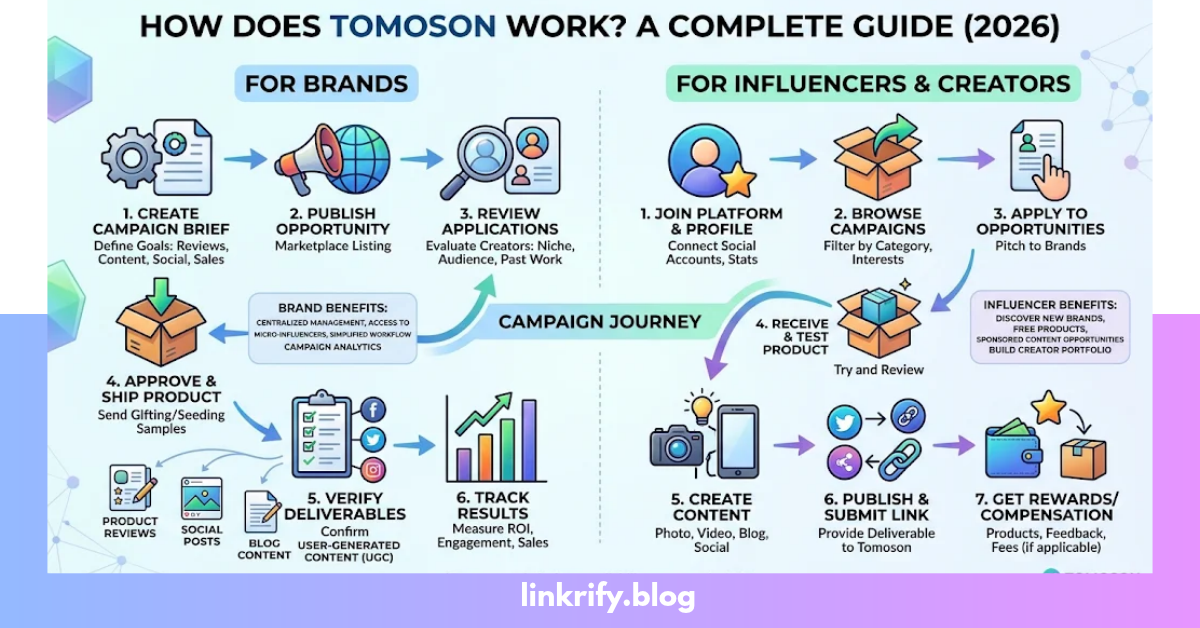
The traditional marketplace model follows a series of steps. Brands publish promotional opportunities, influencers apply, businesses select suitable applicants, and creators complete the agreed campaign activities.
Here is a simplified explanation:
- Brand registration: A business creates an account and prepares its product campaign.
- Campaign creation: The company describes its product, target audience, requirements, and available rewards.
- Influencer applications: Bloggers and creators browse available opportunities and apply.
- Creator selection: The brand checks applications and chooses suitable participants.
- Product delivery: Selected influencers receive the agreed product or promotional offer.
- Content creation: Creators test the product and prepare original content.
- Submission: Influencers provide links to their completed posts or reviews.
- Verification: The brand checks the submitted work against the campaign requirements.
Tomoson’s official documentation describes these responsibilities and the campaign-verification process.
How Does Tomoson Work for Brands?
Brands use influencer marketing to introduce products to audiences that already have an interest in a particular niche. Tomoson’s published marketplace model gives businesses a way to organize these collaborations.
The process begins with a campaign that clearly explains what the company wants to achieve.
1. Create a Brand Account
A business first needs to register and provide the information required by the platform.
A complete brand profile should explain:
- Company name and website.
- Product category.
- Business description.
- Contact information.
- Main marketing objectives.
Accurate information helps creators understand the company before applying.
2. Create a Product Campaign
The brand prepares a campaign describing the product and the collaboration opportunity.
A campaign may include:
- Product name and description.
- Product images.
- Target audience.
- Influencer requirements.
- Campaign objectives.
- Expected content.
- Completion deadlines.
- Product or payment arrangements.
Tomoson’s brand FAQ explains that businesses must provide accurate campaign details and fulfill their product or coupon-code commitments.
3. Select Suitable Influencers
Brands review applicants and choose creators who match their campaign requirements.
For example, a skincare company may prefer beauty bloggers, skincare reviewers, and creators who regularly discuss personal care.
Businesses can consider several factors:
- Audience interests.
- Content quality.
- Website traffic.
- Social media engagement.
- Previous collaborations.
- Relevant experience.
The right audience matters more than follower numbers alone.
4. Provide Products or Compensation
After selecting creators, brands provide the agreed products, coupon codes, or other campaign benefits.
Businesses must explain the arrangement clearly. They should also consider delivery costs, product availability, and the time creators need to complete their assignments.
5. Review Campaign Results
Once influencers submit their work, brands can check whether the content meets the campaign requirements.
Tomoson’s published FAQ describes a dashboard where businesses can find verified review links under the completed campaign section.
This helps businesses organize completed collaborations and evaluate their promotional activities.
How Does Tomoson Work for Influencers and Bloggers?
Tomoson has also described a creator-focused marketplace for bloggers, reviewers, and social media influencers.
The traditional process allows creators to discover brand opportunities and apply for campaigns that match their interests.
Social media influencer marketing. Smiling Asian beauty vlogger reviewing lipstick and cosmetic products while filming with a ring light in her home office.
1. Create an Influencer Profile
Creators need to provide accurate information about their online presence.
A useful profile can include:
- Blog or website address.
- Social media accounts.
- Main content category.
- Audience information.
- Website traffic statistics.
- Previous product reviews.
- Relevant content samples.
A complete profile makes it easier for brands to evaluate an applicant.
2. Find Relevant Campaigns
Influencers can explore opportunities that match their interests and audience.
For example:
| Creator niche | Suitable campaign |
| Beauty | Skincare and makeup products |
| Technology | Gadgets and accessories |
| Food | Kitchen products and food items |
| Fashion | Clothing and accessories |
| Lifestyle | Home and personal care |
| Parenting | Family and children’s products |
| Fitness | Sports and exercise products |
Creators should read the full campaign description before applying.
3. Apply for Opportunities
After finding a suitable campaign, an influencer submits an application.
Brands may evaluate the applicant’s audience size, website statistics, social media presence, and niche.
According to Tomoson’s influencer FAQ, meeting the initial requirements does not always guarantee final approval. Brands make the final selection themselves.
4. Receive and Test Products
Selected influencers receive the product or promotional arrangement described in the campaign.
Tomoson’s documentation states that most products are provided without charge, while some opportunities offer heavily discounted products.
Creators should check whether shipping charges or other conditions apply before accepting an offer.
5. Publish Original Content
Once creators receive and properly test a product, they can prepare their assigned content.
Depending on the campaign, this may include:
- A detailed blog review.
- Product photographs.
- An unboxing video.
- A product demonstration.
- Social media content.
- Honest feedback.
The content should reflect the creator’s actual experience rather than copied promotional language.
6. Submit Proof of Completion
The final step involves submitting valid links to the published content.
Tomoson’s published rules require original work and valid links that lead directly to the actual review or post.
The platform also states that it may remove verification when submitted work does not meet its requirements.
Complete Table: How Tomoson Works Step by Step
The following table compares the traditional workflow for brands and influencers.
| Stage | Brand responsibilities | Influencer responsibilities |
| Account setup | Provide business details | Complete creator profile |
| Campaign planning | Define marketing goals | Identify suitable niches |
| Opportunity listing | Publish product campaign | Browse available campaigns |
| Application | Review creator profiles | Apply for relevant offers |
| Selection | Approve suitable applicants | Wait for brand approval |
| Product delivery | Ship agreed products or provide valid codes | Check product and campaign details |
| Testing | Allow reasonable completion time | Test the actual product |
| Content creation | Explain deliverables | Create original content |
| Submission | Review submitted links | Submit valid post links |
| Verification | Check campaign completion | Correct any submission issues |
| Evaluation | Review campaign outcomes | Maintain professional communication |
This comparison shows how both sides contribute to a successful collaboration.
What Types of Campaigns Does Tomoson Support?
Tomoson’s published brand FAQ describes several campaign objectives. These opportunities help businesses introduce products, collect feedback, and connect with relevant audiences.
Product Review Campaigns
Product-review campaigns allow creators to test products and share their genuine experiences.
For example, a technology blogger might review a wireless keyboard after using it for everyday work.
Sponsored Blog Content
Businesses can collaborate with bloggers who publish content relevant to their products.
The arrangement should clearly identify the required content and compensation.
Social Media Campaigns
Brands may work with creators who publish product-related content on social platforms.
Possible formats include photographs, demonstrations, short videos, and product discussions.
Product Launch Campaigns
Companies introducing new products can use creator partnerships to increase awareness among relevant audiences.
Feedback Campaigns
Businesses may seek genuine product feedback through eligible campaigns.
Tomoson’s brand FAQ specifically mentions third-party review opportunities, including platforms such as Goodreads and Etsy.
Is Tomoson Free for Influencers?
Yes. According to Tomoson’s published influencer FAQ, joining the platform is free for influencers.
However, creators should understand that free membership does not mean every product or campaign comes without costs.
Some opportunities may involve discounted products, and creators should carefully review the offer before accepting it.
For brands, the published FAQ describes a monthly subscription after the free trial. It also states that the trial is limited to one per brand and a maximum of 10 campaigns.
Tomoson Pricing and Potential Costs
| Cost category | Who pays? | Important details |
| Influencer membership | Influencer | Official FAQ describes it as free |
| Brand subscription | Brand | Monthly subscription after the trial, according to the FAQ |
| Product cost | Brand | Depends on the campaign |
| Shipping | Brand | Depends on product delivery arrangements |
| Creator compensation | Brand | Depends on the agreed campaign |
| Discounted product | Influencer | Some campaigns may require payment |
| Campaign expenses | Brand | May include additional promotional costs |
Important pricing note: Tomoson’s public pricing-related material has mentioned plans starting at $49 per month. However, this figure should not be treated as a verified current checkout price. Confirm the available plan, billing terms, and trial conditions directly before paying.
What Are the Main Benefits of Tomoson?
Tomoson’s historical marketplace model offers benefits to both businesses and content creators. Its main purpose is to make product promotion and creator partnerships easier to manage.
Benefits for Brands
1. Access to Relevant Creators
Businesses can search for influencers who create content in specific categories. This helps brands reach audiences interested in their products.
2. Organized Campaign Management
A campaign-based process helps companies manage applications, product delivery, communication, and completed assignments.
3. Product Awareness
Working with bloggers and creators can introduce products to new audiences through reviews and social media content.
4. Customer Feedback
Honest product feedback can help businesses understand customer experiences and identify areas for improvement.
5. User-Generated Content
Brands may receive original photographs, videos, and written content from creators, subject to the agreed usage rights.
Benefits for Influencers
1. Product Testing Opportunities
Creators can discover products that match their interests and content categories.
2. Brand Collaboration
Working with businesses can help bloggers build professional relationships and expand their portfolios.
3. Content Development
Product campaigns give creators opportunities to develop photography, writing, video, and reviewing skills.
4. Potential Compensation
Some collaborations may offer payment, while others provide free or discounted products. The exact arrangement depends on the campaign.
What Are the Requirements for Joining Tomoson?
Before applying for opportunities, creators should understand the platform’s published expectations.
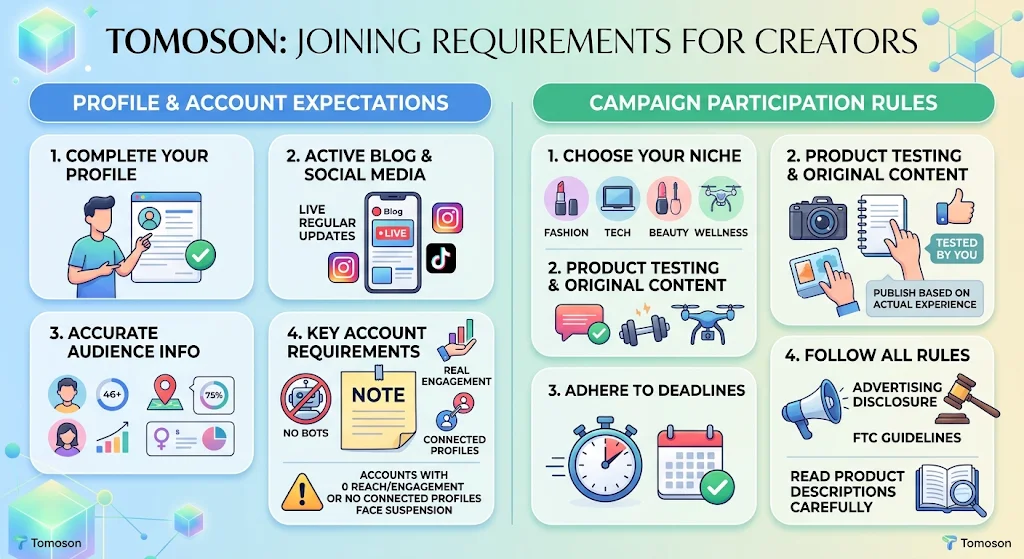
Tomoson’s influencer documentation emphasizes profile completeness, original content, professional communication, and timely campaign completion.
The following requirements can help creators prepare:
- Maintain an active blog or social media presence.
- Provide accurate audience information.
- Choose campaigns that match your niche.
- Read product descriptions carefully.
- Follow the agreed completion deadlines.
- Publish original content based on actual product testing.
- Submit working links to completed posts.
- Follow applicable advertising disclosure rules.
Tomoson also explains that connected social accounts must meet its requirements. Accounts with no connected social profiles or zero reported reach and engagement may face suspension.
How Does Tomoson Help Small Businesses With Influencer Marketing?
Small businesses often have limited marketing budgets. They may not have enough resources to hire an agency or contact hundreds of creators individually.
This is where the traditional Tomoson marketplace model can be useful.
A small business selling handmade skincare products, for example, could look for beauty bloggers interested in testing new products.
The company could then:
- Identify its target customers.
- Prepare a product-review campaign.
- Set creator requirements.
- Review applications.
- Select relevant influencers.
- Deliver products.
- Evaluate completed content.
This approach gives smaller companies a structured way to explore creator partnerships.
However, businesses should not assume that every collaboration will produce sales. Campaign performance depends on audience relevance, product quality, creator credibility, and the strength of the offer.
How Can Influencers Improve Their Chances of Getting Selected?
Competition for attractive brand opportunities can be high. Creators need to demonstrate that they can produce useful content for a company’s target audience.
These practical steps can improve an influencer’s profile.
Build a Clear Profile
Describe your niche, audience, content style, and experience. Avoid exaggerated follower counts or unsupported traffic claims.
Publish Quality Content
Create useful blog posts, product demonstrations, photographs, and reviews.
Brands need to see that you can present products clearly.
Choose Relevant Campaigns
Apply for opportunities that fit your existing audience.
A technology blogger, for example, should prioritize electronics and software rather than unrelated beauty products.
Maintain Good Communication
Respond professionally to campaign messages and discuss delivery or product concerns promptly.
Meet Deadlines
Complete accepted assignments within the agreed timeframe. If shipping or another issue causes a delay, contact the brand as early as possible.
Submit Original Reviews
Describe your actual experience instead of copying product descriptions.
Tomoson’s published rules specifically identify copied content and reviews that do not demonstrate actual product testing as reasons for invalid task verification.
Is Tomoson Safe and Legitimate?
Tomoson has published terms, privacy information, brand FAQs, and influencer guidelines. These documents describe how its historical marketplace operated and establish responsibilities for users.
However, having published policies does not automatically guarantee that every campaign, product, or business listed on a platform is trustworthy.
There is also an important distinction to consider in 2026.
Tomoson’s current About page describes the website as a digital resource that publishes educational content about influencer marketing, social media, and digital entrepreneurship. Its older marketplace FAQs still describe brand and influencer campaign features.
This means users should verify whether marketplace registration and campaign functions are currently accessible before sharing personal information or paying subscription fees.
Important Safety Precautions
Before participating in any opportunity:
- Verify that the official website and registration process work.
- Read the latest terms and privacy policy.
- Check the identity of the business offering the campaign.
- Confirm whether the product is free or discounted.
- Understand shipping and payment responsibilities.
- Avoid sharing passwords or sensitive financial information.
- Keep written records of campaign agreements.
- Never publish a review for a product you have not tested.
Tomoson’s own terms also explain that the company does not endorse products listed by businesses and that users assume responsibility for their participation.
Does Tomoson Allow Honest Product Reviews?
Yes. Honest feedback is a central part of the platform’s published review policy.
Creators are expected to share their actual experiences rather than promise positive opinions in exchange for products or compensation.
This distinction is important because a product review should help readers make informed decisions.
For example, a blogger reviewing a wireless headset should discuss its sound quality, comfort, battery performance, and any problems experienced during testing.
A review should not simply repeat the manufacturer’s marketing claims.
Tomoson’s terms state that creator opinions must remain their own and that reviews should reflect genuine product experiences.
Do Influencers Need to Disclose Free Products?
Yes, when applicable advertising laws require disclosure.
The US Federal Trade Commission (FTC) explains that creators should disclose material relationships with brands, including receiving free or discounted products.
A simple disclosure such as “The brand provided this product for review” helps readers understand the relationship.
Creators should also follow the advertising disclosure requirements that apply in their own countries.
How Does Tomoson Compare With Other Influencer Marketing Methods?
Tomoson’s historical marketplace model focuses on connecting brands and creators through campaign listings.
Other influencer marketing methods use different approaches.
| Marketing method | How it works | Main advantage | Main limitation |
| Tomoson marketplace model | Brands list campaigns and creators apply | Organized product collaborations | Current marketplace availability needs verification |
| Direct influencer outreach | Brands contact creators themselves | Personal communication | Requires manual research |
| Influencer marketing agencies | Agencies manage creator partnerships | Professional campaign support | Can cost more |
| Affiliate marketing | Creators earn commissions through referrals | Performance-based promotion | Depends on conversions |
| Social media marketplaces | Brands and creators discover partnerships | Access to creator networks | Features vary by provider |
| Product sampling programs | Brands distribute products for testing | Product feedback and awareness | Product and delivery costs |
The best approach depends on the company’s budget, audience, product category, and marketing goals.
What Should You Check Before Using Tomoson in 2026?
The most important consideration is the difference between Tomoson’s historical marketplace documentation and its current website presentation.
The official About page now describes an educational publishing resource, while the published FAQs continue to explain an influencer marketplace.
For this reason, anyone researching how does tomoson work should verify these details before attempting to join:
- Account registration: Check whether a working registration page is available.
- Influencer dashboard: Confirm whether creators can access active campaigns.
- Brand dashboard: Check whether businesses can create new opportunities.
- Campaign availability: Look for genuine, current offers rather than relying on old listings.
- Subscription details: Confirm current prices, free-trial conditions, and cancellation terms.
- Payment arrangements: Understand how compensation and product costs are handled.
- Customer support: Verify that the company provides a working support channel.
Do not enter payment information simply because an old pricing page or FAQ remains online.
Is Tomoson Worth Using for Brands and Influencers?
Whether Tomoson is worth considering depends on what you want to achieve.
For brands, its historical marketplace model provides a structured approach to finding creators, distributing products, and reviewing campaign submissions.
For influencers, it describes opportunities to discover products, collaborate with businesses, and develop content portfolios.
However, the current availability of these marketplace services remains an important limitation. Users should confirm that the relevant features work before treating Tomoson as an active source of campaigns.
Who May Benefit From Its Marketplace Model?
| User type | Potential benefit | What to consider |
| Small businesses | Product exposure | Subscription and product expenses |
| E-commerce brands | Creator partnerships | Audience relevance |
| Bloggers | Product-review opportunities | Campaign availability |
| Micro-influencers | Brand collaborations | Profile quality |
| Product reviewers | Testing opportunities | Honest review requirements |
| Marketing teams | Campaign organization | Current feature availability |
For anyone researching how does tomoson work, the key lesson is to understand the documented process while independently checking whether the marketplace is currently accepting users.
Best Practices for Successful Influencer Campaigns
Even when a marketplace makes creator discovery easier, campaign quality still depends on planning and communication.
Brands should focus on clear expectations and genuine audience connections.
Influencers should focus on useful content and honest recommendations.
Here are some practical recommendations:
- Set a specific goal before starting a campaign.
- Select creators based on audience relevance.
- Provide complete product information.
- Agree on content requirements in advance.
- Allow enough time for product testing.
- Keep communication professional.
- Disclose free products and paid partnerships.
- Track referral traffic and conversions where possible.
- Evaluate campaign results instead of relying only on follower counts.
For website owners, there is another important consideration: paid promotional links should follow Google’s link qualification guidelines.
Google recommends using rel=”sponsored” for advertising and paid placements. This helps distinguish commercial links from ordinary editorial recommendations.
Frequently Asked Questions
1. How does Tomoson work for beginners?
Tomoson historically connected brands with bloggers and influencers through product campaigns. Beginners could create profiles, explore opportunities, apply for suitable campaigns, receive products, and submit original reviews after testing them. Current marketplace availability should be checked before registering.
2. Is Tomoson free for influencers?
Yes. Tomoson’s published influencer FAQ states that influencer membership is free. However, some campaigns may offer discounted products rather than completely free samples. Always check the campaign conditions before applying.
3. Do brands have to pay to use Tomoson?
Tomoson’s published brand FAQ describes a free trial followed by a monthly subscription. Brands must also consider product expenses, shipping, and creator compensation. Confirm current subscription prices directly before making a payment.
4. Can bloggers receive free products through Tomoson?
According to its published influencer FAQ, most products were provided without charge, while some campaigns offered heavily discounted products. Creators needed to check the individual campaign requirements before accepting an opportunity.
5. Does Tomoson guarantee influencer earnings?
No. A creator should not assume that joining a platform guarantees paid campaigns or regular income. Opportunities depend on brand selection, campaign availability, creator suitability, and the agreed compensation.
6. Is Tomoson still working in 2026?
Tomoson’s website remains accessible and publishes educational content. However, its current About page describes a digital publishing resource, while its older FAQs describe influencer marketplace services. Public documentation alone does not confirm that new marketplace campaigns are currently operational. Verify registration and dashboard access before committing money or sharing sensitive information.
Conclusion
Understanding how does tomoson work helps brands and influencers evaluate its traditional approach to product promotion and online collaborations. The platform’s published marketplace model explains how businesses create campaigns, select creators, distribute products, and review submitted content.
For bloggers and influencers, the model offers a way to discover product opportunities and build relationships with businesses. For brands, it provides a framework for organizing product reviews, collecting feedback, and reaching relevant audiences.
However, users should pay particular attention to Tomoson’s current operating status. Its older marketplace documentation does not establish that all historical features remain available in November 2026. Verify registration, campaign access, pricing, and payment conditions before joining.
Have you used Tomoson or another influencer marketing platform? Share your experience in the comments to help other brands and creators make informed decisions.